How to Teach Division Area Model: A Fun and Engaging Guide for Teachers and Parents
Are you tired of the same old boring division methods that leave your students (and you) snoozing? Well, it's time to wake up and get excited about the Division Area Model! This method not only makes division fun and interactive but also reinforces the concept of place value. In this blog, we'll dive into the world of Area Model Division so grab your pencils and let's divide and conquer!
Why Use the Division Area Model? Before we get into the nitty-gritty, let's talk about why the Division Area Model is so fantastic. This method breaks down a large division problem into smaller, more manageable pieces. It's like eating a pizza one slice at a time rather than trying to stuff the whole thing in your mouth at once (although, let’s be honest, who hasn’t tried that at least once?). Using the Division Area Model helps students understand the concept of place value, making it easier for them to grasp division. Plus, it visually represents the problem, which can be a game-changer for visual learners. And who doesn't love a good chart?
The Standard: What Are We Aiming For? According to the Common Core State Standards (CCSS.Math.Content.4.NBT.B.6), students in the 4th grade should be able to: "Find whole-number quotients and remainders with up to four-digit dividends and one-digit divisors, using strategies based on place value, the properties of operations, and/or the relationship between multiplication and division. Illustrate and explain the calculation by using equations, rectangular arrays, and/or area models." Basically, we want our students to divide like math ninjas, slicing through numbers with precision and confidence.
Tips and Tricks for Teaching the Division Area Model
1. Start with the Basics
Begin with 2-digit by 1-digit division problems before moving on to 3-digit and 4-digit problems. This helps build confidence and ensures students understand the basic concept before tackling more complex problems.
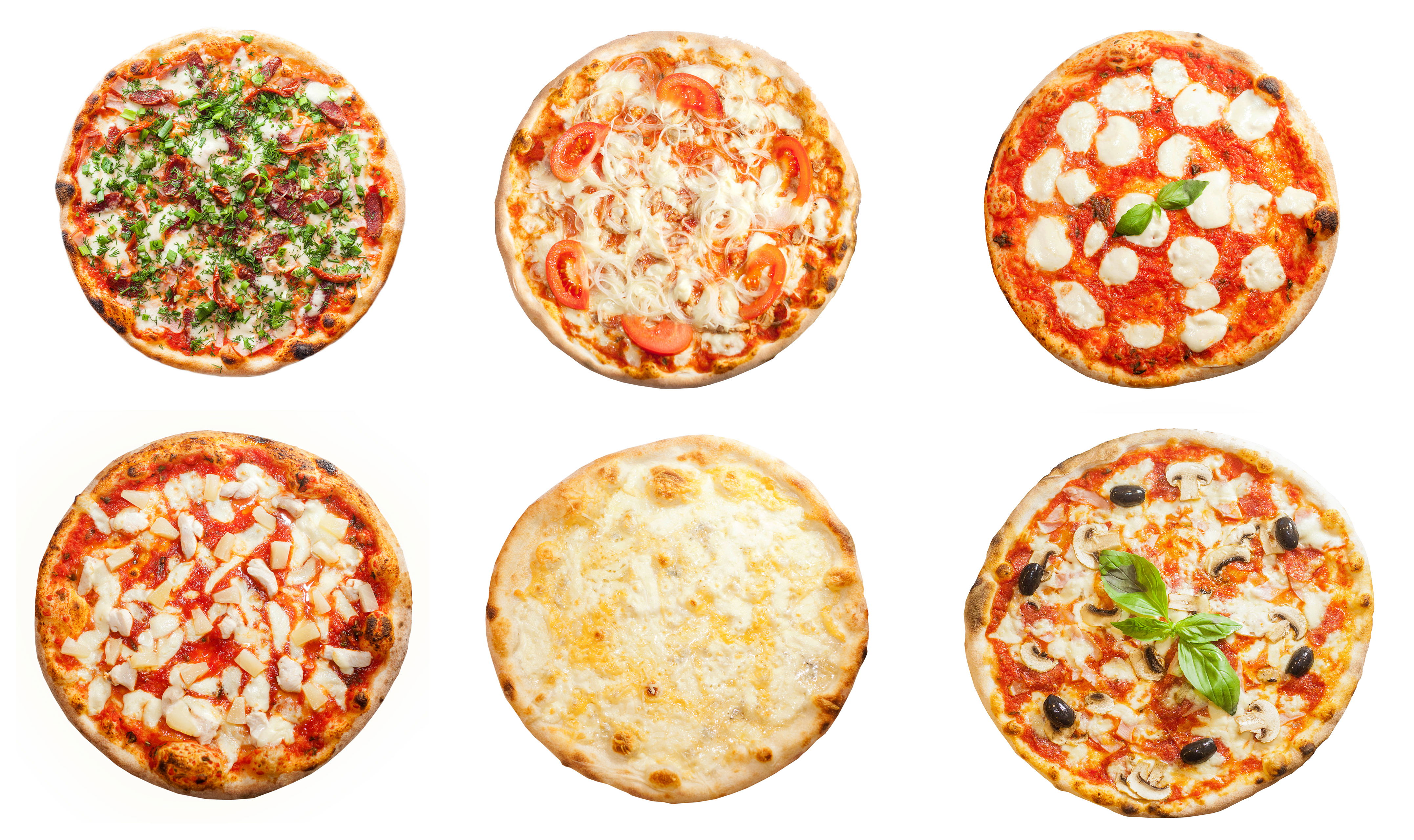
2. Use Real-Life Examples Relate division problems to real-life situations. For instance, ask how many pizzas we need to buy if each pizza has 8 slices and we have 32 people at a party. This makes the math more relatable and less abstract.
3. Incorporate Humor Math can be fun! Use jokes and light-hearted examples to keep students engaged. For example, "Why was the equal sign so humble? Because it knew it wasn't less than or greater than anyone else!"

4. Practice, Practice, Practice Repetition is key. The more students practice, the more comfortable they will become with the Division Area Model. Use our worksheets regularly for homework, classwork, or even as a fun math center activity.
5. Encourage Group Work Let students work in pairs or small groups. This encourages collaboration and allows students to learn from each other. Plus, it makes the activity more social and enjoyable.

6. Celebrate Success Celebrate small victories. When a student successfully solves a problem, give them a high-five, a sticker, or just a big smile. Positive reinforcement goes a long way in building confidence.
Breaking Down a Division Area Model Problem Let's walk through a sample problem to see how the Division Area Model works. We'll start with a simple 3-digit by 1-digit problem: 456 ÷ 3.
Step 1: Break It Down First, break down the number 456 into smaller parts based on place value. In this case, we have:
- 400 (hundreds place)
- 50 (tens place)
- 6 (ones place)
Step 2: Create the Area Model Draw a rectangle and divide it into three sections, one for each part of the number:
- The first section will represent the hundreds (400)
- The second section will represent the tens (50)
- The third section will represent the ones (6)
Step 3: Divide Each Section Next, divide each section by the divisor (3):
- 400 ÷ 3 = 133 (with a remainder of 1)
- 50 ÷ 3 = 16 (with a remainder of 2)
- 6 ÷ 3 = 2 (with no remainder)
Step 4: Add the Quotients Add up the quotients from each section:
- 133 (from the hundreds)
- 16 (from the tens)
- 2 (from the ones)
Total: 133 + 16 + 2 = 151
Step 5: Consider the Remainders Combine the remainders: 1 (from the hundreds) + 2 (from the tens) = 3 So, 456 ÷ 3 = 151 with a remainder of 3.
Sample Area Model Division Problems
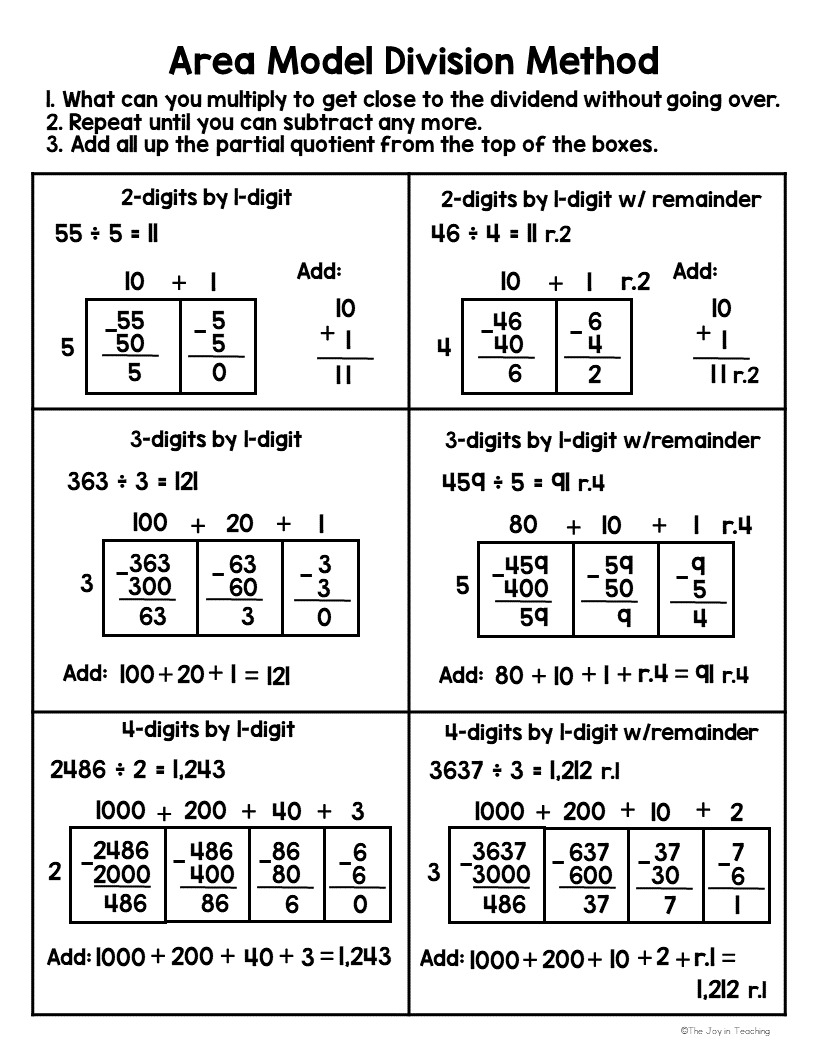
2-Digits by 1-Digit (55 ÷ 5)
- Break down 55 into 50 and 5.
- Divide each part by 5:
- 50 ÷ 5 = 10
- 5 ÷ 5 = 1
- Add the partial quotients: 10 + 1 = 11
2-Digits by 1-Digit with Remainder (46 ÷ 4)
- Break down 46 into 40 and 6.
- Divide each part by 4:
- 40 ÷ 4 = 10
- 6 ÷ 4 = 1 with a remainder of 2
- Add the partial quotients and remainder: 10 + 1 = 11 with a remainder of 2 (11 r.2)
3-Digits by 1-Digit (363 ÷ 3)
- Break down 363 into 300, 60, and 3.
- Divide each part by 3:
- 300 ÷ 3 = 100
- 60 ÷ 3 = 20
- 3 ÷ 3 = 1
- Add the partial quotients: 100 + 20 + 1 = 121
3-Digits by 1-Digit with Remainder (459 ÷ 5)
- Break down 459 into 400, 50, and 9.
- Divide each part by 5:
- 400 ÷ 5 = 80
- 50 ÷ 5 = 10
- 9 ÷ 5 = 1 with a remainder of 4
- Add the partial quotients and remainder: 80 + 10 + 1 = 91 with a remainder of 4 (91 r.4)
4-Digits by 1-Digit (2486 ÷ 2)
- Break down 2486 into 2000, 400, 80, and 6.
- Divide each part by 2:
- 2000 ÷ 2 = 1000
- 400 ÷ 2 = 200
- 80 ÷ 2 = 40
- 6 ÷ 2 = 3
- Add the partial quotients: 1000 + 200 + 40 + 3 = 1243
4-Digits by 1-Digit with Remainder (2486 ÷ 2)
- Break down 2486 into 2000, 400, 80, and 6.
- Divide each part by 2:
- 2000 ÷ 2 = 1000
- 400 ÷ 2 = 200
- 80 ÷ 2 = 40
- 6 ÷ 2 = 3
- Add the partial quotients: 1000 + 200 + 40 + 3 = 1243
A Helpful Resource to Support Learning
If you’re looking for an easy way to reinforce this strategy, our Division Area Model Worksheets are designed to support students step by step. The activities focus on breaking division problems into smaller, manageable parts using clear visual models. They’re perfect for classroom practice, math centers, homework, or extra support at home—making division feel less overwhelming and more approachable for learners.
Customer Testimonials:
⭐⭐⭐⭐⭐ Amber O. says, This was a great find on TPT. It's so hard to find worksheets for area model division. I found that this resource fit perfectly with the i-Ready curriculum I am currently using.
⭐⭐⭐⭐⭐ Candice W. says, This is a great resource to use to teach the area model for division! I like how you can start with smaller numbers and then work your way up to the larger numbers that the standard requires.
⭐⭐⭐⭐⭐ Leah J. says, “Absolutely love this resource! It’s well-organized, easy to use, and saved me so much planning time. My students were engaged and the materials were clear, visually appealing, and aligned perfectly with standards. Definitely worth it—thank you for creating such a high-quality product!.“
⭐⭐⭐⭐⭐ Mrs. P. says, “This was a great resource to help my students understand the process. I loved how we could start small and work our way up to larger numbers! I highly recommend!!”
⭐⭐⭐⭐⭐ Yariddyn M. says, “Your resources are awesome. Just love how well organized they are and easy to use. Just print and go.“
Conclusion
Teaching division using the Area Model can turn a challenging concept into a meaningful and engaging learning experience. By breaking problems into smaller parts and using visual representations, students build a stronger understanding of both division and place value. With the right strategies and consistent practice, division doesn’t have to feel intimidating—it can be fun, confidence-building, and even a little exciting (kind of like a pizza party… without the mess!)
Follow Me for More Teaching Tips with Joy For more tips, resources, and a daily dose of teaching joy, follow me on:
Got questions or want to share your success stories? Drop me an email at thejoyinteaching@gmail.com. I love hearing from fellow educators and parents! Happy Teaching!
Joy Medalla